Most of my writing here deals with how to enrich your players' experiences as roleplayers, but there are other details to consider when you want to run a game. Specifically, as a GM, you'll need to have certain props and tools on hand to represent your game in action. There are the basics: dice, maps, and figurines/minis. And now that D&D is more popular than ever, there are a handful of extra tools you can procure to make things even more exciting. At the time of writing, there is a pandemic which has driven most D&D games out of the in-person mode, but we will return to in-person adventures eventually. Let's start with the basics and how to get them.
What every game will need is dice. You can roll digitally with any of the many tools offered for that purpose, but most players and GMs enjoy physical dice more. There's something pleasant about dropping a real die onto the table, and you can't stack digital dice, so you'll probably want to get some physical dice to play. You can get standard sets of the 7 dice pretty much anywhere, but if you're a GM and you're looking to start your collection, I recommend the Chessex Pound of Dice. It's between 80 and 100 dice of varying colors and patterns. Any given set will include a few full sets of mismatched dice. It's okay that they're mismatched--that means that your players get to build custom dice sets, and that's something they'll likely enjoy.
You can and should also consider getting matched sets of dice. As I mentioned, there are many places to get sets of dice--there are entire companies which do nothing but create dice for tabletop games. I generally recommend starting with Etsy because there are so many good options out there (truly impressive dice sets which are absolutely unique). And you'll be supporting small businesses of gaming-minded entrepreneurs, which means you're contributing to the community. But feel free to branch out; there are more dice on the internet than you can imagine, so find the ones that suit you. I personally have a set of dice in each color to provide my players and myself with options, but whatever works for your game is best for you.
Once you have dice, it's time to get a map. You have a lot of options with maps. You could grab some posterboard or butcher's paper and draw maps onto the paper, but this often means lots of prep time and it's hard to reuse your maps. You could invest in mapping products, like the ones that build 3D maps, but these can be expensive and difficult to reuse. My preferred method of dealing with the map problem is to go with Chessex again and get a battlemat. Battlemats are affordable, gridded for one-inch squares and hexes sized for miniatures, and endlessly reusable--just draw on it with a wet erase marker and you'll be able to depict any location with just a moment's sketching on the vinyl mat. Erasing is as easy as running a damp rag over the mat. If you get a multi-color pack of markers, you can depict a decent level of detail. And even if you're not a visual artist, your drawings will be enough to give your players a sense of what is where, and that's all that matters.
An important consideration with maps for the average session is that it be the right size. Chessex offers three sizes of battlemat, and the smallest size is enough for most encounters. But for larger engagements that actually resemble a battlefield, you may need to go up a size. The largest size mat is big enough that many tables will struggle to hold it all, but the middle sized mat (the Megamat) is about appropriate for almost anything. I personally have one Megamat and two Battlemats (the small one), and I will usually draw a central location like a favorite tavern or an NPC's headquarters on one of the Battlemats and leave it for when the players return to it; I use the Megamat for encounters. Whatever strategy you choose, be ready to make the most out of your map.
Finally, now that you have a map to put them on, you might want some miniatures. There are, like with dice, nearly endless places to find minis. You can shop individual minis at many sites like Miniature Marketplace, but for GMs starting their collections, there is a much more cost-effective way to build your mini army. My secret was eBay. If you browse eBay for D&D figures, you'll find entire collections of pieces for very cheap. An average individual piece at Miniature Marketplace will run about $8, but on eBay, you can get lots of pieces at a rate of about $1-$2 per piece. I managed to get a collection of about 200 pieces for $100 as well as sets of early D&D figures by renowned artists for very little money. My collection of D&D minis currently sits at about 1,000 pieces, which provides a great deal of customization for my players when they choose pieces.
How will you store your impressive collection of minis now that you have them? I recommend tackle boxes (the fishing accessory). These handy boxes will allow you to easily transport your minis while keeping them organized. I personally have my minis organized by what weapon the figure is holding, and a tackle box keeps your pieces in order without any effort. Something like this will work well, but browse your options and consider which boxes will suit you best. What matters the most is that you get what you need from your materials, and it's important that you can rely on the organization you select.
There are generally two kinds of minis you can obtain. There are the classic pewter or otherwise metal pieces, and there are plastic pieces. The metal pieces will always cost more--look for collections of them to make the most of your money. The metal pieces can be more attractive as options if you're looking to paint your minis, but you can paint a plastic piece as well. I'm not a committed mini painter--I've done a few, and they are very much the prize gems in my collection--but your own interest will guide you here. Getting into painting pieces is a pricy investment, so you may find that after obtaining all the necessary materials to play, you may need to put painting on the back burner. But if painting the minis is part of the appeal of the game, get in there and beautify your minis!
Since we're addressing necessary physical components, let me add this to your shopping list: paper and pencils. Even if you're using digital character sheets, the players should have access to scrap paper for taking notes, keeping a character journal, and otherwise tracking important information. Even more importantly, I recommend buying a multi-pack of mechanical pencils for your players. People need to be able to make erasable notes on their character sheets, and no one wants to stop to sharpen a pencil mid-game; the humble mechanical pencil resolves both of those issues. Make sure to have plenty on hand when you play.
One simple prop that can help your game is a basic whiteboard. You're already using wet erase markers for your maps, and there are many applications of a whiteboard. You can get a small tablet for cheap, and I recommend recording initiative orders on the board and displaying it--this way, your players can easily reference the combat order and be ready on their turns. You can also write riddles on the board so players can mull over the details without your having to repeat them. And it always helps to be able to draw symbols and diagrams without cluttering up your map. A whiteboard is simple, but it has many helpful applications in a game.
As I have said, D&D has never been more popular, and as a result, there are more game aids you can buy than ever before. Many players like the thrill of dice towers--not a stack of dice, but a physical tower with randomizing bumps you can drop your dice into. Etsy again has a great stock of these, both in the form of ready-made towers and designs you can build yourself. And if you're sufficiently practical and creative, you can design your own. All it takes is looking at some designs and crafting your own take on it.
A tool which can be helpful especially to beginning players that is new to 5th edition D&D is spellbook cards. Wizards of the Coast recognized the complexity of spellcasting and locating all the details of each spell, so they released the spellbook cards, which place every detail of a spell on a playing card-sized card so that spellcasters can simply leaf through the cards and know what they need to cast the spell. As I mentioned, these are great for beginning players, but even experienced players can benefit from the help offered by these cards. They can be a little pricy depending on where you look, but they are well worth the benefit. I have the cards for each class as well as two sets of the Arcane spells since three classes use them and there are sometimes more than one arcane spellcasters in a party. If you're like me, you'll want to keep these cards organized by spell level, so ask your players to be considerate of how they're organized.
Likewise, you can add all manner of D&D peripherals to your game experience. Many players like to have a dice tray or other designated place to roll dice without the threat of losing them. Some players like to punish misbehaving dice with a turn in dice jail. And there are dozens of options for more specific tracking items, like inspiration trackers, spell slot trackers, and condition markers. I don't use many accessories like this, but they can be very helpful in making all of combat's complicated details more visible. The key to picking which tools will help you is in asking this question: Does this improve my players' experience of the game? If so, go for it; if not, save your money and make your game more special with your creativity.
One physical item I have obtained which I think has been a bonus to my playing experience is something I had custom made. When I first designed my homebrew setting, I wrote that there was an inter-governmental treaty to share a common currency (my way of explaining how several different societies shared one monetary system). I designated who was on each coin and why--the orcish leader at the time appeared on the platinum piece because the orcish lands were richest in platinum deposits, for example. I designed images to appear on each coin and had custom poker chips made, so now I have a collection of chips that all look like my in-game currency. I'm proud of how they look, and when I have players engage in a real card game like Three Dragon Ante, they can use facsimiles of real D&D money.
 |
| The designs for my homebrew currency. |
To make these coins, I selected portraits of D&D races that I liked as representations of the world; then I came up with translations for each metal for the circular text. I used a silhouette of the continent of the homebrew setting and a quote from the halfling who called for the coining of a common currency. This is a bit of a screwball when it comes to D&D accessories. No one really needs to have currency simulators, and in fact, the first custom chip company I contacted found my design so strange that they refused to do it (perhaps if I had asked for naked ladies on the chips, they would have agreed, since that appeared to be their main business). But I was passionate about my homebrew design for money, and having physical coins can be great for roleplaying experiences. I recommend that if you are passionate about an element of your homebrew setting and you conceive of an idea for how to bring it to life, do it! Your players will recognize and feed off of your passion, and the game will be richer for it.
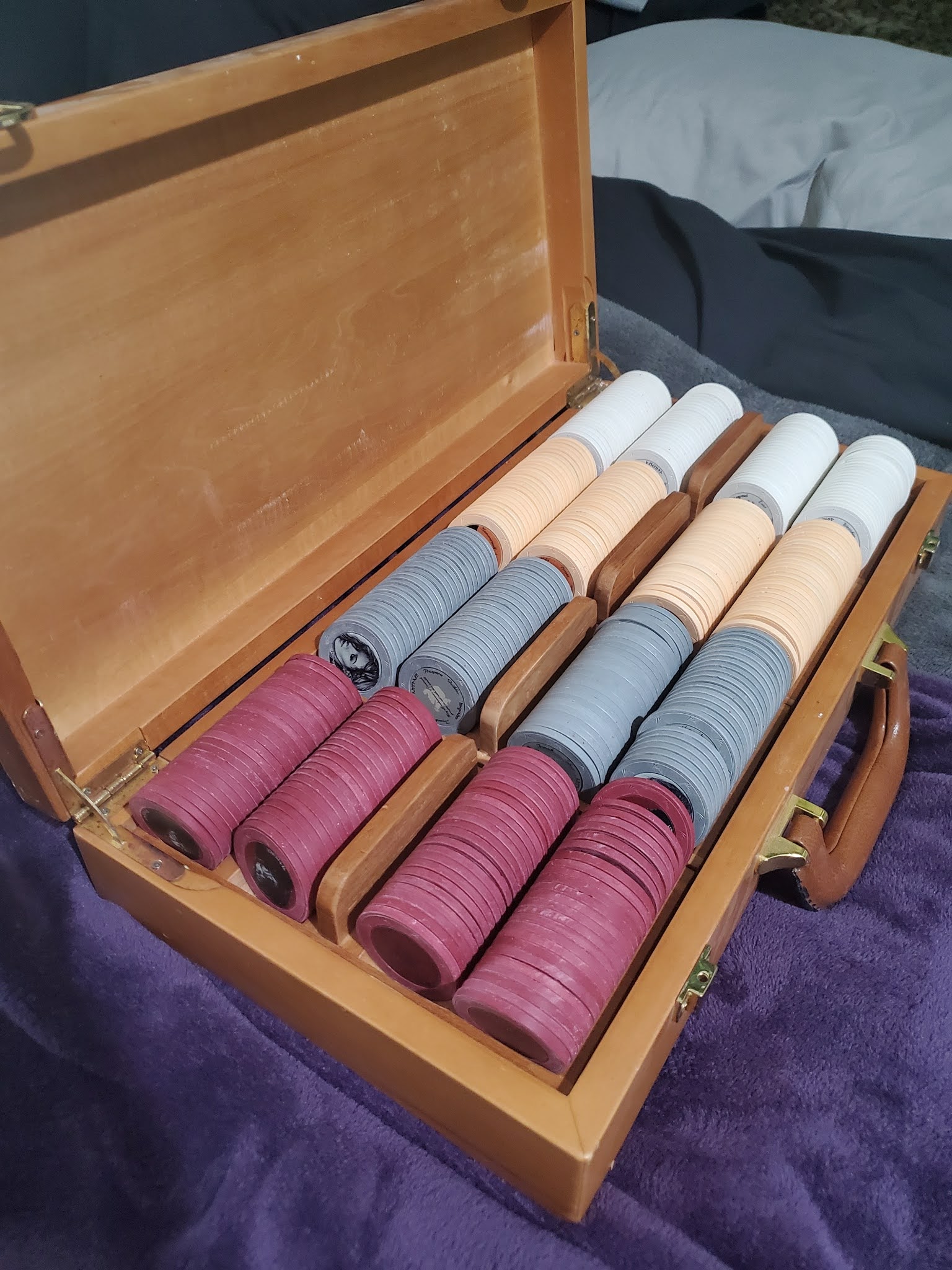 |
| The coin chips in their carrying case. |
This may come as a surprise after this list of possible peripherals, but my bottom line advice is this: you don't really need any materials to play beyond character sheets. If you're looking to become a GM with all the materials, these will get you well on your way to that goal. But if you're simply looking to get players invested, you can do a lot more with a twisty story than you can with accessories. Remember that the most important thing is that your props and accessories help your players engage. If players are ignoring initiative order because they won't stop rolling with the dice tower, you may need to reevaluate what the real role of your accessories is. But by and large, tools like these will help players get invested more easily. Whatever routes you choose for your D&D peripherals, have fun! These tools amount for the most part to toys, and toys should be fun.
Hopefully, this guide helps you to get a grip on the many decisions you'll face about how to run your game as a GM. Coming soon: how to build a cohesive party, alternate uses for my expanded Wild Surge Table, and why I believe TRPGs are the most interesting games of our time. As always, if there's something I didn't cover here or you would like to see written about here, comment below! Until next time, happy gaming!
Back to the homepage (where you can find everything!)


